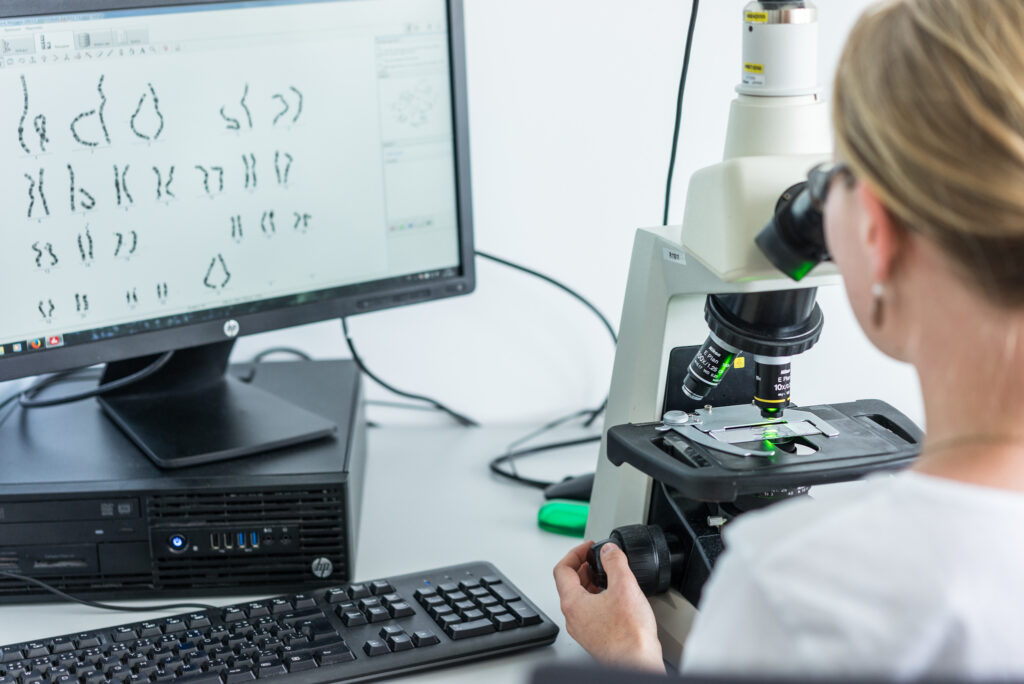
A genetic disease can be caused by a change in a single gene, but also by a deviation in the number or structure of chromosomes. Some genetic diseases are inherited from parents, while others arise de novo. What does carrier status mean, how many chromosomes does a person have, and how can genetic testing help when planning a baby? We provide a clear overview and explanation of when to seek genetic counseling.
What are chromosomes and how many does a person have
In most nucleated body cells, a person usually has 46 chromosomes, arranged in 23 pairs. One chromosome in each pair comes from the mother and the other from the father. Exceptions include eggs and sperm, which normally contain 23 chromosomes. During fertilization, their genetic information combines. What autosomes and sex chromosomes X and Y are, and what happens when their number or shape changes, is explained in detail in the article on human chromosomes.
Both genes and chromosomes can contain changes. However, not every difference in DNA signifies a disease. To assess its significance, it is important to know what kind of change it is and how it relates to a person’s health status.
How the inheritance of genetic diseases works
A genetic disease is related to a change in genetic information. An inherited disease is one whose cause can be passed from parents to offspring. These terms overlap, but they do not mean exactly the same thing. The mode of inheritance depends on the specific gene and the type of change.
Autosomal dominant inheritance
In dominant inheritance, a pathogenic change in one of the two copies of a specific gene may be sufficient for the disease to develop. Examples include Marfan syndrome or Huntington’s disease. Symptoms can vary in severity and may not appear at the same age.
If one parent has a pathogenic variant in one copy of an autosomal gene, the probability of passing it to a child is usually 50% in each pregnancy. However, for some diseases, inheriting the variant does not guarantee the same symptoms as the parent.
Autosomal recessive inheritance
In recessive diseases, causal pathogenic variants in both copies of the same gene are usually required for the disease to develop. Parents can be healthy carriers: each has a change in only one copy of the gene and may not be aware of their carrier status.
If both partners are carriers of a pathogenic variant in the same gene for a given recessive disease, in each pregnancy there is usually a:
- 25% probability that the child will have the disease,
- 50% probability that they will be a carrier,
- 25% probability that they will not inherit either of these variants.
This does not mean that exactly one out of four children will have the condition. The 25% risk applies independently to each conception. It also matters whether both parents carry a disease-causing variant in the same gene. If they are carriers for two different recessive conditions involving different genes, that alone does not create this 25% risk.
X-linked inheritance
Some diseases are related to genes on the X chromosome. These include, for example, hemophilia or Duchenne muscular dystrophy. In a male with XY chromosomes, a change on the single X chromosome can have a different impact than in a female with two X chromosomes. In X-linked diseases, males are more frequently affected. Females are often carriers of the disease, having one healthy chromosome (without the mutation) and one with the mutation. Fragile X syndrome is also an X-linked disease. However, its inheritance is more complex because it involves the expansion of a repeating segment in the FMR1 gene. It cannot be simply classified among common recessive diseases.
A genetic disease can also arise de novo
A change in DNA can occur during the formation of an egg or sperm or during early embryonic development. It is referred to as de novo, meaning newly arisen. A child can therefore have a genetic disease even if it has not previously occurred in the family. If the change is also present in their germ cells, they can later pass it on to their offspring.
Most common types of genetic diseases
Genetic diseases include various groups of conditions. Their frequency varies by population and specific diagnosis, so it is not appropriate to list them all as equally common.
Chromosomal diseases
These are caused by a change in the number or structure of chromosomes. A change in the number of individual chromosomes is called aneuploidy. In trisomy, a specific chromosome is present in three copies instead of two.
A well-known example is Down syndrome, which is most often associated with trisomy of the 21st chromosome. Most cases arise de novo and are not inherited from parents. However, other forms exist, such as translocation, where a chromosomal rearrangement in one parent may play a role.
Structural changes include, for example, the loss of a part of a chromosome or the relocation of its segment. In the glossary, you can find them under the terms chromosomal mutations and aberrations. Some rearrangements may not cause difficulties for their carrier but can affect reproduction.
Sometimes the deviation affects only some of the cells. In such cases, we speak of mosaicism, the significance of which depends, among other things, on the type of change and the proportion of individual cell lines.
Monogenic diseases
Monogenic diseases are related to a change in a single gene. Well-known examples include:
- Cystic fibrosis: an autosomal recessive disease associated with the CFTR gene, which mainly affects the respiratory and digestive systems. Read also the explanation of the term cystic fibrosis.
- Spinal muscular atrophy: the most common form is related to the SMN1 gene and is inherited in an autosomal recessive manner. It affects the nerve cells controlling movement and leads to muscle weakness.
- Marfan syndrome: usually an autosomal dominant connective tissue disease that can affect the skeleton, eyes, heart, and blood vessels. The article What is life like with Marfan syndrome? provides more details.
Multifactorial diseases
In some diseases, the influence of multiple genes combines with the environment and lifestyle. Examples include type 2 diabetes or certain cardiovascular diseases. Genetic predisposition here means an increased susceptibility, not a certainty that the disease will develop. The risk cannot be expressed by the same simple rule as for monogenic diseases.
Rare genetic diseases
In the European Union, a disease is considered rare if it affects fewer than 5 in 10,000 people. It is estimated that most rare diseases have a genetic cause and many manifest in childhood. Individually they are rare, but together they affect a large number of families. Many of them, especially recessively inherited ones, can be identified in future parents through carrier screening, which we describe below. Every year, Rare Disease Day, which falls on the last day of February, is dedicated to them.
How genetic risk can be determined before pregnancy
Genetic testing before conception can help identify selected risks while you still have time to make decisions. It can also make sense for a couple who feels healthy and wants to conceive naturally. Carrier status often does not manifest in any way.
Genetic counseling and karyotype testing
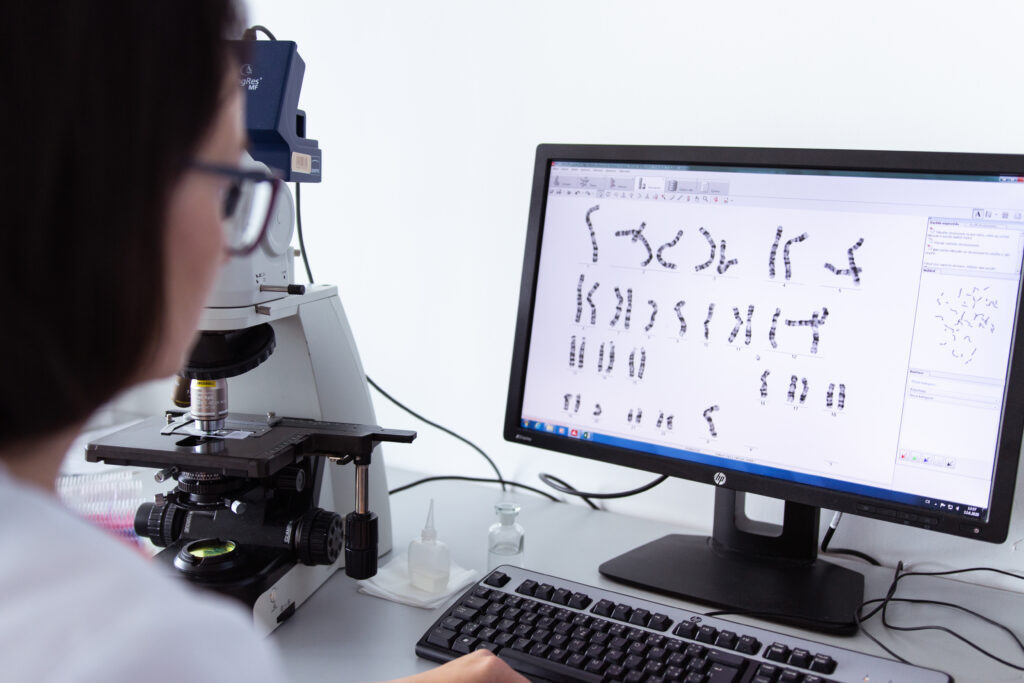
During a consultation, a clinical geneticist will assess personal and family history and recommend appropriate tests. One option is a karyotype, which examines the number and structure of chromosomes. It helps detect, for example, certain rearrangements related to recurrent miscarriages. However, it does not examine all genes, and a normal karyotype does not rule out monogenic diseases.
Carrier screening
Carrier screening looks for selected pathogenic variants associated with recessive and X-linked diseases. The ACMG recommends offering appropriate screening to people planning pregnancy as well as those already pregnant. A negative result reduces the risk but does not eliminate it completely.
At Repromeda, one option is the PANDA test. Testing both partners allows for the assessment of their joint reproductive risk within the scope of the diseases tested. The term genetic compatibility does not mean a guarantee of the future child’s health. Details can be found on the preconception genetic testing page.
What if the testing reveals an increased risk
The geneticist will explain the findings and discuss options for further action. For some couples, IVF with preimplantation genetic testing of embryos (PGT) may be appropriate. PGT-M focuses on specific monogenic diseases, PGT-SR on the consequences of structural chromosomal rearrangements, and PGT-A on changes in the number of chromosomes. These tests have different purposes and do not automatically replace each other.
Bring any available medical records and genetic test results from your relatives to your genetic consultation. These will help the geneticist better assess your family medical history.
How genetic testing is performed
The examination begins with a conversation about health status, family, and the reason for testing. The doctor will explain what the test can find and what its limits are. How the examination at Repromeda is performed, what tests we offer, how much they cost, and how long they take is described in the article How genetic testing is performed.
Genetic tests in pregnancy
During pregnancy, you may choose a non-invasive prenatal test (NIPT) such as PrenatalAdvance. NIPT is a screening test that estimates the risk of certain chromosomal abnormalities. It cannot confirm a diagnosis. If the result indicates a high risk, a consultation is needed and diagnostic testing should be offered, for example through chorionic villus sampling or amniocentesis. NIPT does not replace prenatal ultrasound scans.
When to seek genetic counseling
A consultation is particularly suitable if:
- an inherited disease or a known pathogenic variant occurs in the family,
- you are a carrier of a genetic disease,
- you have a child with a congenital defect or genetic disease,
- you have experienced recurrent miscarriages or are addressing possible genetic causes of infertility,
- testing during pregnancy showed an increased risk or an unusual finding,
- you need to discuss the influence of age on reproductive risks.
With a woman’s increasing age, the probability of certain chromosomal deviations, such as trisomy 21, increases. However, this does not mean that all genetic diseases only affect older parents.
Are you planning to have a baby and want to better understand your genetic risks? Book a genetic consultation at Repromeda. We’ll review your family medical history with you and discuss which testing options may be right for you.
Frequently asked questions about genetic diseases
No. Some arise from a new change in DNA, referred to as de novo, or a new chromosomal deviation. A genetic disease can therefore appear even in a family where it has not occurred before.
Usually 46, which is 23 pairs, in most nucleated body cells. Eggs and sperm normally have 23 chromosomes. Some genetic conditions are associated with a different number.
Yes. For example, both parents can be healthy carriers of the same recessive disease. In such a case, the risk of an affected child is 25% with each conception. Another possibility is a newly arisen genetic change.
No. Every test has a certain scope and limitations. It can detect or reduce selected risks, but it cannot rule out all causes of health problems nor always predict the severity of symptoms.
Sources
[1] MedlinePlus Genetics. What is a chromosome?
[2] MedlinePlus Genetics. How many chromosomes do people have?; NHGRI. Chromosome. Additional link: NHGRI – Chromosome
[3] MedlinePlus Genetics. What is a gene variant and how do variants occur?
[4] MedlinePlus Genetics. What are the different ways a genetic condition can be inherited?
[6] MedlinePlus Genetics. Fragile X syndrome.
[7] MedlinePlus Genetics. Can changes in the number of chromosomes affect health and development?
[8] MedlinePlus Genetics. Down syndrome.
[9] MedlinePlus. Karyotype Genetic Test.
[10] MedlinePlus Genetics. Cystic fibrosis.
[11] MedlinePlus Genetics. Spinal muscular atrophy.
[12] MedlinePlus Genetics. Marfan syndrome.
[13] MedlinePlus Genetics. What are complex or multifactorial disorders?
[15] MedlinePlus Genetics. What happens during a genetic consultation?
[16] Repromeda. Preconception genetic testing.
[17] Repromeda. PGT: preimplantation genetic testing.
[18] PrenatalAdvance. Non-invasive prenatal testing.
[19] ACOG. Prenatal Genetic Screening Tests.
[20] MedlinePlus Genetics. Why might someone have a genetic consultation?
[21] MedlinePlus Genetics. What are the risks and limitations of genetic testing?
[22] MedlinePlus Genetics. Can changes in the structure of chromosomes affect health and development?