

The possibility to preserve your own eggs, sperm, or embryos for future use is one of the greatest advances in modern reproductive medicine. Thanks to cryopreservation and its most advanced form – vitrification – reproductive cells can be safely stored for many years without losing their quality.
These methods offer women and men the opportunity to postpone parenthood while preserving their reproductive health for the future. They are also widely used in infertility treatment, oncology care, and IVF cycle planning.
What is cryopreservation?
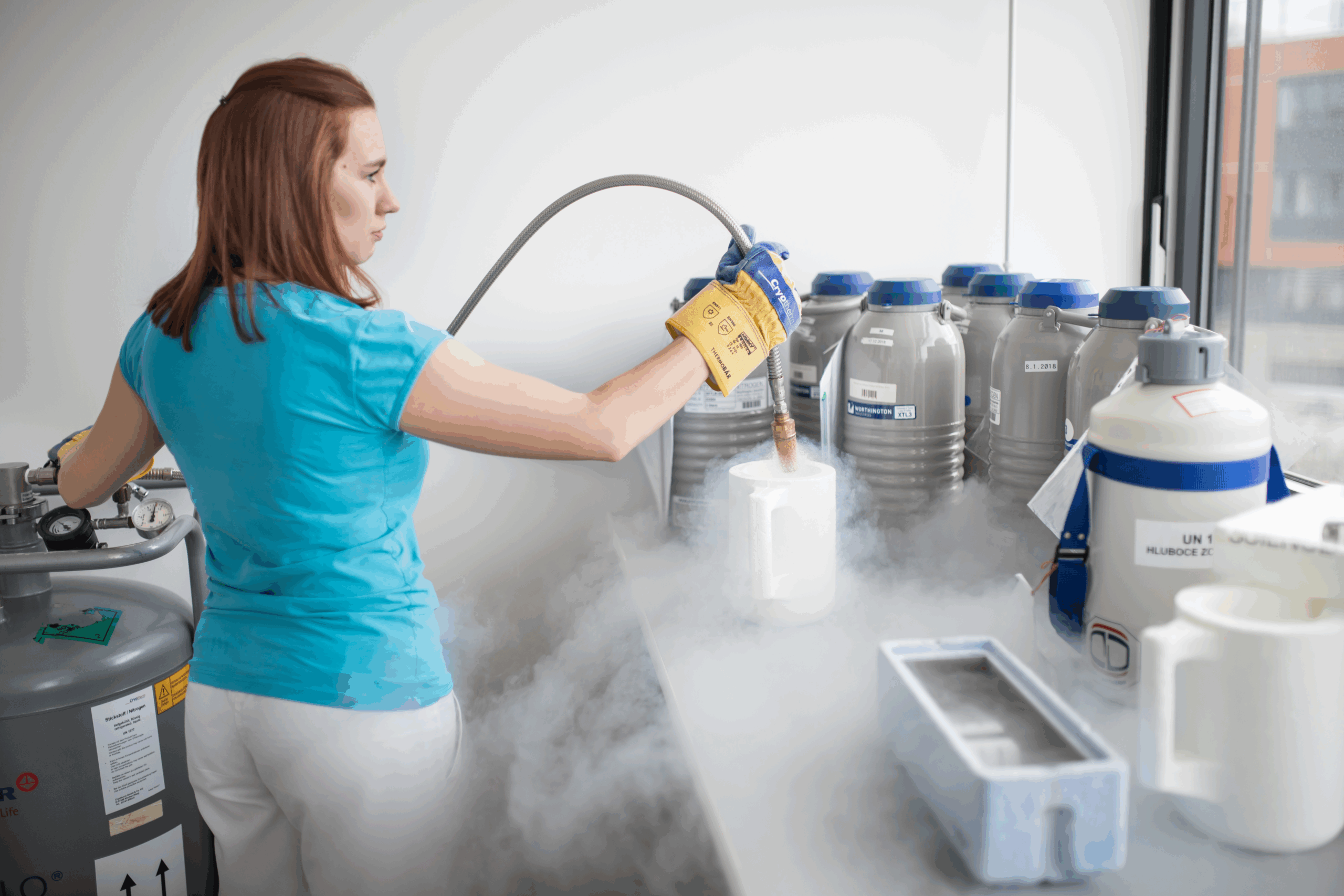
Cryopreservation means storing reproductive cells (eggs, sperm) or embryos in a frozen state at extremely low temperatures, typically –196 °C, using liquid nitrogen.
The goal is to stop all biological processes so that cells retain their quality and viability even after many years. Once thawed, they can be used for fertilization and infertility treatment.
Today, cryopreservation is a routine part of reproductive medicine. It allows people to plan parenthood according to their life circumstances and helps ensure that cell quality remains the same as at the time of collection.
What is vitrification and how does it differ from cryopreservation?
Vitrification is a modern form of cryopreservation that has largely replaced the older slow-freezing method for embryos and oocytes.
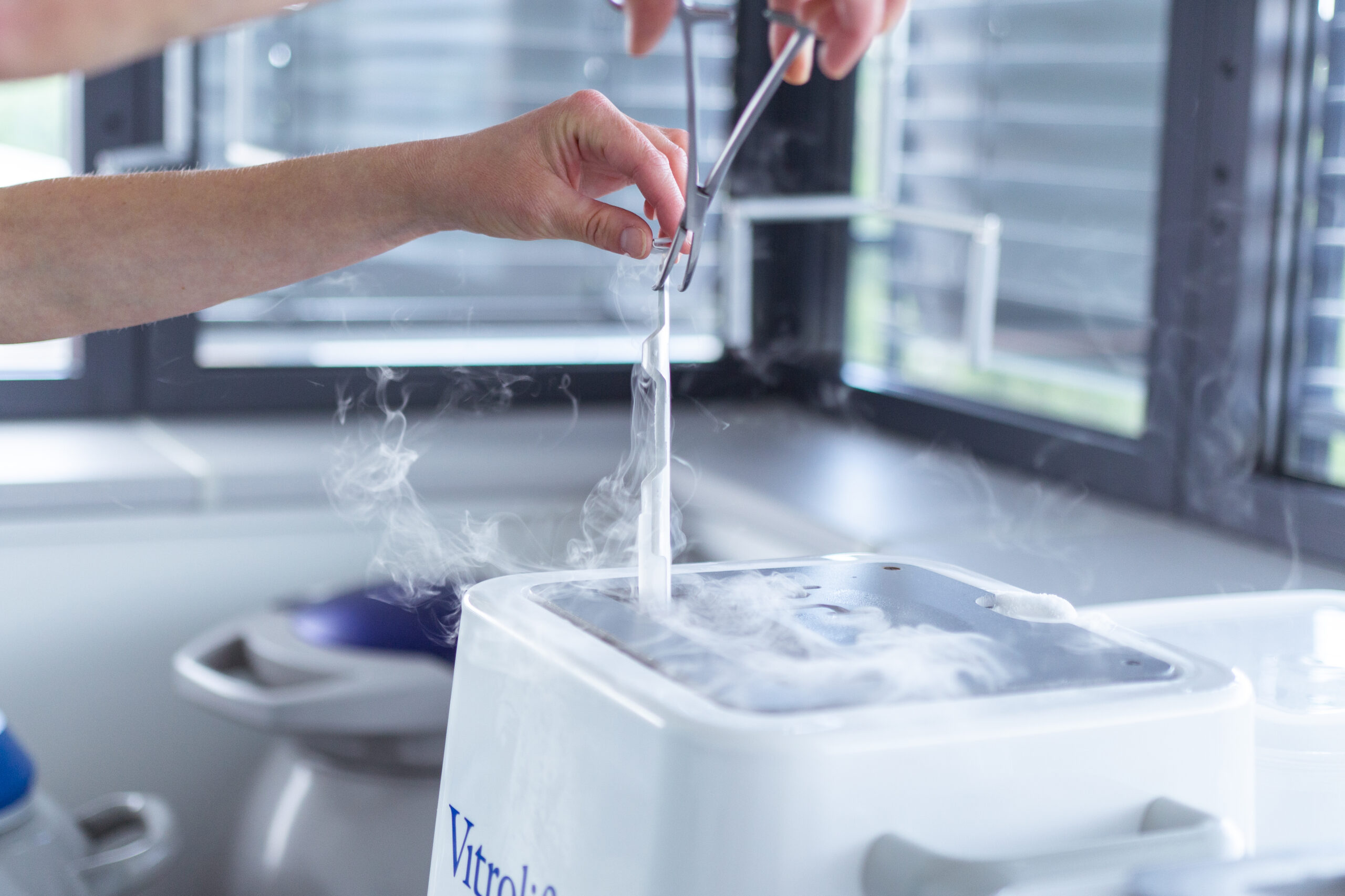
Slow freezing gradually cools cells and carries a risk of ice crystal formation, which can damage cell structures. With vitrification, ice crystals do not form. Cells are cooled extremely rapidly, creating a glass-like state instead of ice. This prevents cellular damage and results in significantly higher survival rates after thawing.
Vitrification of eggs and embryos represents a major breakthrough. Survival rates after thawing now reach approximately 95–99 %, which was unthinkable with older techniques.
When does vitrification play an important role?
In modern reproductive medicine, vitrification is used in several situations:
- Before oncological or other treatments that may affect fertility.
- When postponing parenthood (social freezing), for example if a woman does not yet have a partner or wishes to focus on her career.
- During IVF, when more embryos are created than can be transferred immediately.
- For ethical or religious reasons, when a couple does not wish to create more embryos than they plan to use.
- For men before surgery, medication, or in occupations that pose a risk to fertility.
- As part of a Split program, where some eggs are donated and others are preserved for personal future use.
Who are fertility preservation methods suitable for?
- Women who wish to preserve their fertility for the future. After the age of 35, egg quality declines significantly, so timely freezing helps maintain the chance of having a biological child.
- Men prior to medical treatment or in high-risk occupations.
- Couples undergoing IVF who want to store embryos for future cycles.
- Oncology patients who need to preserve the possibility of parenthood after treatment.
- Transgender individuals before starting hormone therapy.

How does the process of collecting and freezing eggs, sperm, and embryos work?
The entire preservation process is always carried out under the supervision of experienced specialists. Every step is essential to ensure excellent cell quality after thawing.
- Medical consultation – an individualized plan is established based on the patient’s health and future plans.
- Cell collection – in women, eggs are retrieved after hormonal stimulation during a short anesthesia; in men, sperm is collected by masturbation into a sterile container.
- Quality assessment – an embryologist evaluates which cells are suitable for freezing.
- Vitrification – cells are combined with cryoprotectants (solutions that protect cells from damage caused by low temperatures), rapidly cooled, and stored in liquid nitrogen at –196 °C.
Storage and thawing – cells can be stored in liquid nitrogen for many years; once thawed, they are ready for use in treatment.
Each egg or embryo undergoes individual evaluation. Only cells with developmental potential are selected for freezing. Precision is crucial – during vitrification, the embryologist has only a few dozen seconds to complete each step. This makes vitrification technically demanding, but thanks to advanced technology and the expertise of embryologists, it is now extremely safe.
Success rates and risks of cryopreservation and vitrification
Embryos frozen using vitrification maintain high quality, and success rates after transfer (known as FET – frozen embryo transfer) are comparable to, or even higher than, those of fresh embryo transfer.
One reason is that during FET, a woman’s body has more time to prepare the uterine lining without the hormonal burden associated with stimulation. The uterine environment is therefore more natural and often better prepared for embryo implantation.
Risks are minimal and mainly depend on the quality of embryos before freezing, the woman’s age at the time of egg retrieval, and her overall health.
Today, the “freeze-all” strategy is often used, in which all embryos are vitrified first and transferred later. This approach provides great flexibility for both patients and physicians when planning the transfer and reduces the risk of complications (such as ovarian hyperstimulation syndrome). It also allows time for genetic testing of embryos, enabling the selection of the most suitable embryo for transfer.
Social freezing at Repromeda
Social freezing is not about postponing motherhood for convenience. It is a conscious investment in the future and in preserving the possibility of having a genetically related child, even as biological time moves on.
Repromeda has long expertise focused on quality and an individualized approach.
At our clinics in Brno and Ostrava, we offer not only preventive egg preservation using vitrification, but also the unique SPLIT program – a combination of donation and personal preservation. A woman can donate part of her eggs to help other couples, while keeping part for her own future use.
Through the Split program, women can combine solidarity with personal security – helping others while protecting their own future.
Vitrification at REPROMEDA
At Repromeda, vitrification is a routine and highly successful procedure performed by a team of top embryologists and specialists who are among the most experienced in the Czech Republic.
Thanks to precise laboratory work and an individualized approach to patients, Repromeda achieves excellent results in both the preservation and subsequent use of reproductive cells and embryos.
Cryopreservation and vitrification are now essential tools of modern reproductive medicine. They allow us to give patients time – and in reproduction, time is often the most valuable resource of all.